The Developer Workflow Problem Nobody Talks About
Modern software development has never been more powerful — yet teams still spend a surprising amount of time fighting their tools. The challenge is not the tools themselves. It is the friction between them.
Modern software development has never been more powerful.
A developer sitting in a home office today has access to more computing power, more frameworks, more cloud services, more databases, and more automation than entire engineering departments had available twenty years ago. The tooling ecosystem has exploded, AI has become part of daily workflows, and spinning up global infrastructure is now measured in minutes rather than months.
Yet despite all this progress, many engineering teams still spend a surprising amount of time fighting their tools.
Not because the tools are bad. Most are excellent at solving individual problems. The challenge is that modern development workflows rarely involve a single problem.
A developer investigating a production issue may start by reviewing application logs on a remote server. That leads to a database query. The query reveals unexpected data. The developer then needs to inspect an API response, validate payloads, trace a service call, review a migration, compare schemas between environments, and perhaps deploy a fix.
Each task is individually straightforward.
The friction appears in the transitions.
One application for SSH. Another for databases. Another for API testing. Another for file transfers. Another for tunnels. Another for documentation. Another for deployment visibility.
By the end of the day, engineers have spent as much time moving between tools as they have solving the actual problem.
The industry often talks about reducing complexity within systems. Much less attention is given to reducing complexity between systems.
That distinction matters.
The Cost of Context Switching
Context switching has become one of the most underestimated productivity drains in software engineering.
The issue is not merely opening multiple applications. Every tool introduces its own interface, authentication model, workflow conventions, terminology, shortcuts, and operational assumptions.
An engineer investigating a database issue may jump from a cloud console to an SSH client, into a database client, then into an API testing platform before finally returning to an IDE. Each transition forces the brain to reload context.
The cost compounds over time.
It becomes particularly visible during incident response when teams are under pressure and every minute matters. A production issue rarely arrives neatly packaged within the boundaries of a single system. More often it crosses databases, infrastructure, APIs, authentication services, storage layers, and deployment environments simultaneously.
Unfortunately, the tooling ecosystem still tends to treat these domains as separate worlds.
Developers do not.
Infrastructure, Data, and APIs Are No Longer Separate Disciplines
There was a time when infrastructure teams managed servers, database administrators managed databases, and developers focused primarily on application code.
Those boundaries have largely disappeared.
Today's developer is often expected to understand cloud infrastructure, networking, databases, security controls, deployment automation, container orchestration, observability, and AI-assisted workflows.
The rise of platform engineering and DevOps accelerated this convergence.
As a result, developers increasingly move between three operational domains every day:
Infrastructure. Data. Connectivity.
Infrastructure provides access to environments. Data provides insight into what is actually happening. APIs connect services together.
When something goes wrong, developers rarely investigate just one of these areas in isolation. They investigate all three.
A Real-World Example
Imagine a customer reports that orders are intermittently failing within an e-commerce platform.
The first instinct may be to inspect application logs. An engineer opens an SSH session to the production server and begins reviewing system activity.
Nothing obvious appears.
Attention shifts to the database. Querying the orders table reveals several incomplete transactions. Additional investigation shows records are being created but not fully processed.
At this point the focus moves again.
The developer needs to inspect the API responsible for submitting those orders. Requests are replayed. Responses are validated. Headers are checked. Authentication tokens are examined. Test payloads are generated and compared.
Eventually the root cause emerges.
A subtle API contract change introduced an unexpected edge case that propagated through the application stack and ultimately manifested as incomplete database records.
Notice something important. The issue was never purely an infrastructure problem. It was never purely a database problem. It was never purely an API problem. It was an operational workflow problem. And that is becoming increasingly common.
The Rise of Operational Tooling
The next generation of developer tooling is likely to focus less on isolated capabilities and more on operational continuity.
Developers do not necessarily need more tools. They need fewer workflow interruptions.
This is where operational platforms become interesting. Rather than treating databases, infrastructure, and APIs as independent activities, modern tooling can begin to recognise that these systems are deeply connected parts of the same workflow.
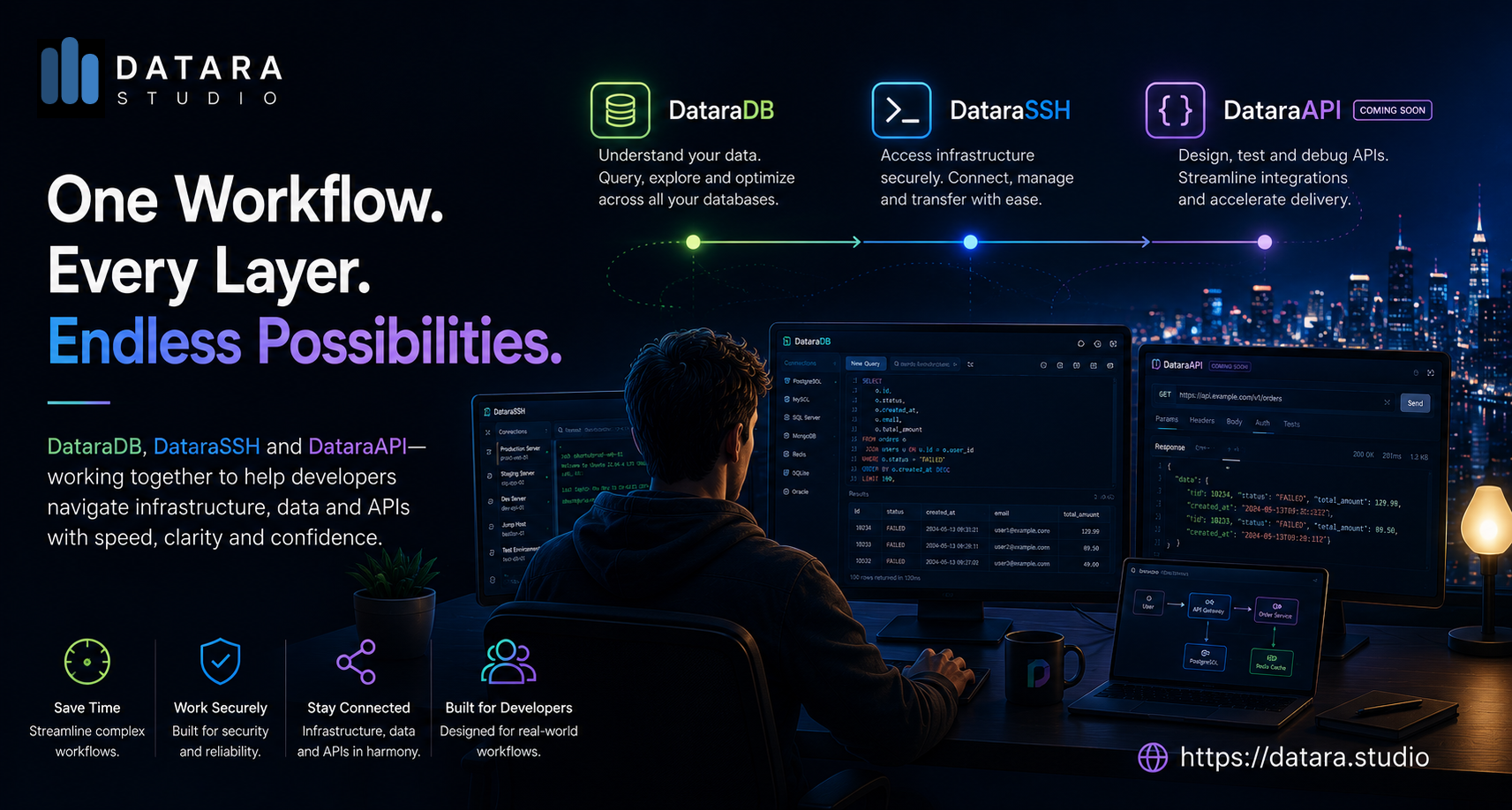
That philosophy sits behind Datara Studio.
DataraDB: Understanding the Data Layer
DataraDB was built around a simple observation. Modern applications are generating more data than ever, but understanding that data often remains surprisingly difficult.
Developers routinely work across PostgreSQL, MySQL, SQL Server, Oracle, SQLite, Redis, and MongoDB. They compare schemas, review migrations, troubleshoot performance issues, generate documentation, and increasingly use AI to accelerate query development.
DataraDB brings these workflows into a modern, high-performance environment that focuses on practical day-to-day engineering work rather than simply acting as a database browser.
The goal is not merely to execute queries. The goal is to understand systems. Because when something breaks, the database often tells the story first.
DataraSSH: Accessing the Infrastructure Layer
Of course, data rarely exists in isolation. Applications live on servers, containers, cloud platforms, virtual machines, and edge environments.
That means developers still need reliable access to infrastructure. SSH remains one of the most important technologies in modern computing because secure remote access continues to underpin operational workflows across virtually every industry.
DataraSSH was created to modernise that experience. Rather than treating SSH as a standalone utility, DataraSSH is designed as a practical operational workspace for developers and infrastructure teams who need secure connections, port forwarding, file transfers, jump hosts, and environment management without unnecessary complexity.
Infrastructure should be easy to access. Not difficult to navigate.
DataraAPI: Completing the Workflow
Coming soon to the Datara Studio platform is DataraAPI.
If DataraDB helps developers understand data, and DataraSSH helps them access infrastructure, DataraAPI is designed to help them understand connectivity.
Modern applications increasingly communicate through APIs. They power integrations, internal services, partner ecosystems, mobile applications, SaaS platforms, AI systems, and automation workflows.
Yet API testing, validation, documentation, and lifecycle management often remain disconnected from the environments and databases they interact with.
DataraAPI aims to bring those workflows closer together. Because developers rarely investigate APIs without eventually touching infrastructure or data. And they rarely investigate infrastructure or data without eventually touching APIs.
The Operational Workflow Platform
Taken individually, DataraDB, DataraSSH, and DataraAPI solve familiar problems. Together, they reflect a broader shift occurring within software engineering.
The industry is moving toward operational workflows rather than isolated tooling categories. Developers are no longer simply writing code. They are navigating interconnected systems that span infrastructure, databases, APIs, cloud environments, security boundaries, and increasingly AI-assisted workflows.
The tools that succeed in the coming years will likely be the ones that recognise these realities and reduce the friction between them. Not because engineers need more features. But because they need more continuity.
The future of developer productivity may not be about building better database clients, better SSH clients, or better API tools in isolation. It may be about building a better operational workflow across all three.